
The Thames Path
The Source > Cricklade> Lechlade > Tadpole Bridge > Newbridge > Oxford > Abingdon > Shillingford > Pangbourne > Sonning > Henley-on-Thames > Marlow > Maidenhead > Eton > Staines-upon-Thames > Shepperton > Hampton Wick > Richmond > Putney Bridge > London Bridge > Thames Barrier
0 – 294.7/297.2 km (let’s call it an even 296 km)
[Surge stats: 403.45 km, 359 floors, 619921 steps]
After two days of rest following the rigors of the SWCP, I was ready and raring to go on this new challenge. The Thames Path (TP) doesn’t exactly test your lung capacity, but it certainly is a test of endurance. Depending on which side of the river you choose to walk through the London section, the TP is either 294.7 km (south side) or 297.2 km (north side). Either way, it’s a very long way. The TP guides I’ve read suggest a 14-day schedule, but that’s without hauling a pack. I had the beast, and I was still footsore from the SWCP. I decided to putter along over 20 days, with a plan to go out relatively hard for the first half, then scale back the daily distance to give me time to do things other than walk – such as explore towns and tourist sites, read a book or two, enjoy some quality time in pubs and restaurants, and maybe even write this blog.
A couple of notices:
My chosen reading on the TP will be The Wind in the Willows by Kenneth Graham, and Three Men in a Boat by Jerome K. Jerome. Both are classic Thames reads. I’m not going to get all book-club on you, but for anyone interested in vicariously enjoying the Thames vibe through earnest Mole or the absurd J, feel free to read along.
Getting away from my day-to-day narration of the swcp, this blog will be more of a themed look at the Thames and my impressions from walking beside and over it. For the most part, I’m going to let the pictures do the talking.
Ready? Excellent. Let’s go…
The Upper Reaches
The Source > Cricklade> Lechlade on Thames > Tadpole Bridge > Newbridge > Oxford
0 – 86.8 km
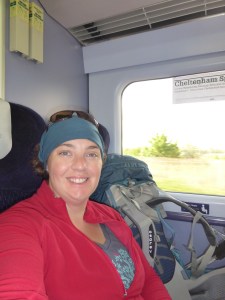
Like all good things, it started at the very beginning, and the very beginning of the Thames is called The Source. The Source, though, is on the edge of a field in the middle of nowhere. To get there you have to get to Kemble (the closest town to The Source), and to get to Kemble I had to get a train. This is me and the beast looking primed for adventure…
At Kemble train station I got my bearings, aided by my fabulous National Trail Guide, and walked east ten minutes or so to where the Wysis Way intersects with the Thames Path. It seemed wrong to pay much attention to the Thames at this point since I hadn’t yet seen The Source, but there was an information board here about the landscape and the wildlife thereabouts that I read alongside a guy who ended up becoming my walking companion for half the day. Providential, hey? Carefully averting our eyes from the river, we chatted about our TP plans on the 2 km walk upstream to the stone that marks the spot where a spring (sometimes) seeps. As you can see, there wasn’t much water about. Weeks of dry weather will do that. But, I assure you, it does become a river. Judge for yourself, but to my mind, the stone looks far too much like a tombstone…


While we were taking photographic evidence of our presence at The Source, another couple and their rambunctious dog arrived. Technically, I hadn’t even started the TP yet, and already there was a community to share it with.
And so, I began the TP…
As you can see, there wasn’t much water about. At first, it’s just a dry stream-bed, then you see a few puddles, they start to link together, and then it’s a stream, becoming a creek, that gets larger and larger until, eventually, it could generously be called a river, just. Once it gets big enough to house water fowl, the landscape around it had morphed from undulating hills to a very wide flood plain that did more to convince that this is indeed a river than the river itself.


This first section of the Thames – what I referred to as The Upper Reaches – winds its way through farmland, wild meadow, and woodland, with an occasional village or town to break up the stunning, green, idyllic landscape. Both on and around it, the life the river sustains is abundant. Living on the river were many water fowl. And, since it is spring, the multitude of chicks, and ducklings, and cygnets, and goslings, provided hours of amusement as I trundled along. The geese were a particular favourite – forming into huge, protective armadas, with the gentlemen geese out the front honking ferociously until I, or any other perceived risk, had passed.


But water fowl weren’t the only birds to amaze.
Just outside Cricklade (day 2), I heard a rat-a-tat-tatting noise that sounded like electronica music, only it came from a hedge that bordered the Thames. I asked a passing woman who was out walking her dog (lots of people have dogs here). She said it was a robin. Really? I asked. I was under the impression that robins tweeted. Amazing sound for a little bird. Some producer should sample it. They’d make a killing.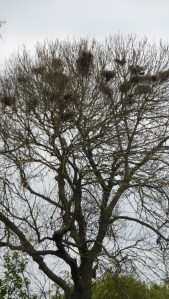
Every now and then I’ve seen scarlet kites that swoop and soar over the valley, looking for dinner, no doubt. They’re beautiful to watch, but impossible to photograph.
Where the TP comes close to Kelmscott Manor (home to William Morris – the Victorian-era designer) there was a huge flock of black birds living high in a bunch of trees. They made a huge racket. On the day I walked from Newbridge to Oxford I got to talking to a couple of bird enthusiasts. They told me, with a great deal of certainty, that these were rooks.
Animals of the non-feathered variety abound too, some a little harder to see and photograph than others.


Being nocturnal, I never saw any moles, but their mounds littered the path…


…creating one sort of danger. The other hazards were the stinging nettles. Bazillions of stinging nettles! Those of you who remember the impact nettles had my final day on the SWCP might be concerned that they might have me running far from the path, but no, I stuck it out. Phew!


After getting stung multiple times on the first day, I mentioned my hate for all things nettles to my walking companion. He said there was a plant that often grew along side stinging nettles that you can rub on the affected skin to reduce the sting. Only, he couldn’t remember what it was called or what it looked like. We searched a few patches of nettles, but didn’t find anything. I kept a lookout for large-leaved plants near nettles, and only came up with the ones in the bottom left pic which are as big as pumpkin leaves. I didn’t need any new injuries – I was already suffering from sore-toe-syndrome (with a colourful big-toe nail that I fancied looked an awful lot like a mauve opal, I was convinced I was going to lose it).
Days later, on the approach to Oxford, when talking to the aforementioned bird-enthusiasts (one of whom was bravely wearing shorts), they said it was the other plant in the bottom right pic. Take note anyone who’s prone to swiping their hands on nettles.
Getting back to fauna on the TP, plenty of human animals live on the river too. It took two days of walking for the river to have grown deep enough for boats to navigate safely, but once I’d reached Lechlade on Thames the canal boats came thick and fast.


And canal boats meant locks…


With my focus primarily on the river, the locks and weirs did take centre-stage. Initial intrigue lead me to interrogate the first lock-keeper I met, at Buscot Lock. He’d been lock-keeping for thirty-odd years and ran a tight ship, taking pride in the lock and the weir and the landscaping around. He answered every question I could think to ask about how the lock and weir system worked.
By the Beast and I got to Pinkhill Lock, I felt ready to help out…


Following the course of the river isn’t exactly hard, but there are times when other streams lead into the Thames, or there are multiple potential paths, or the path needs to divert around danger areas, buildings, or through towns, and you need a bit of guidance to figure out where to go. Signage in the Upper Reaches was actually pretty good.


Of course, I wasn’t on a boat. I was walking beside the river, through cattle fields, small copses of woods, the occasional crop, and meadow after meadow of wildflowers. I couldn’t even begin to name all the trees and flowers I came across. As with birds, my response to plants is not to catalogue (where others might say “oh, that’s a Whosiwhatsit Specificus, from the Fabuloso family”, I say “Aw, isn’t that lovely”, take a mental picture, and move on). I appreciate the aesthetic delight. In the Upper Reaches, the flowers are generally small and unassuming – delightful, but you won’t see them at the Chelsea Flower Show. On mass, they’re delicious. I dare anyone to walk through a meadow full of daisies and dandelions and buttercups and ragweed and whatever else you can see amongst the grass, and not smile.


One moment that has stayed with me was walking between a patch of ragweed by the river and a rape seed crop. It reminded me of a battle, or of rival football fans – two sides competing for supremacy. I came out the other end with my right half covered in yellow.

The twisty-turning course of the Thames threw me a few times. Having lost my compass on the SWCP, and with few landmarks in the broad floodplain to indicate how far I’d come, I was reliant on converting the km on my surge to the map’s mile markers. The first lock didn’t come along till the third day on the TP. Till then it was distant farm houses, bridges, pubs, and church spires that give some kind of indication of my location, with very occasional stops through villages. The two pics below of small concrete buildings on the river side are actually pill boxes – built during WWII as a final defence. They’re kind of creepy.


One particularly beautiful church was the St John the Baptist church at Inglesham. Saved from Victorian ‘repairs’ by William Morris, this church wears it’s 800 years of history beautifully.


Of course, each day ended with a stay at a hotel or B&B. I have an unfortunate tendency to choose old places with character (and little network access):


I haven’t mentioned much about the people I met on the TP. Unlike on the SWCP, very few walkers were doing the path all in one go. Looking back, I think there were probably no more than seven or eight people I saw. Only one carrying a full pack, and he was going in the other direction. Most TP walkers were doing day walks, or weekends at the very most. The bulk of people on the TP were walking their dogs for an hour or so. All showed a suitable level of amazement at my endeavour, which, of course, I lapped up.
The wide, green Upper Reaches ends on the long approach to Oxford, where the TP takes on a different kind of feel. But that, as they say, is a story for another day…

 PenLoper
So enjoyed your meandering Pen. Great eye in your pictures. Twitchers, “wildlife” and juxtaposed oddities well captured!
Looking forward to next instalment…
LikeLiked by 1 person