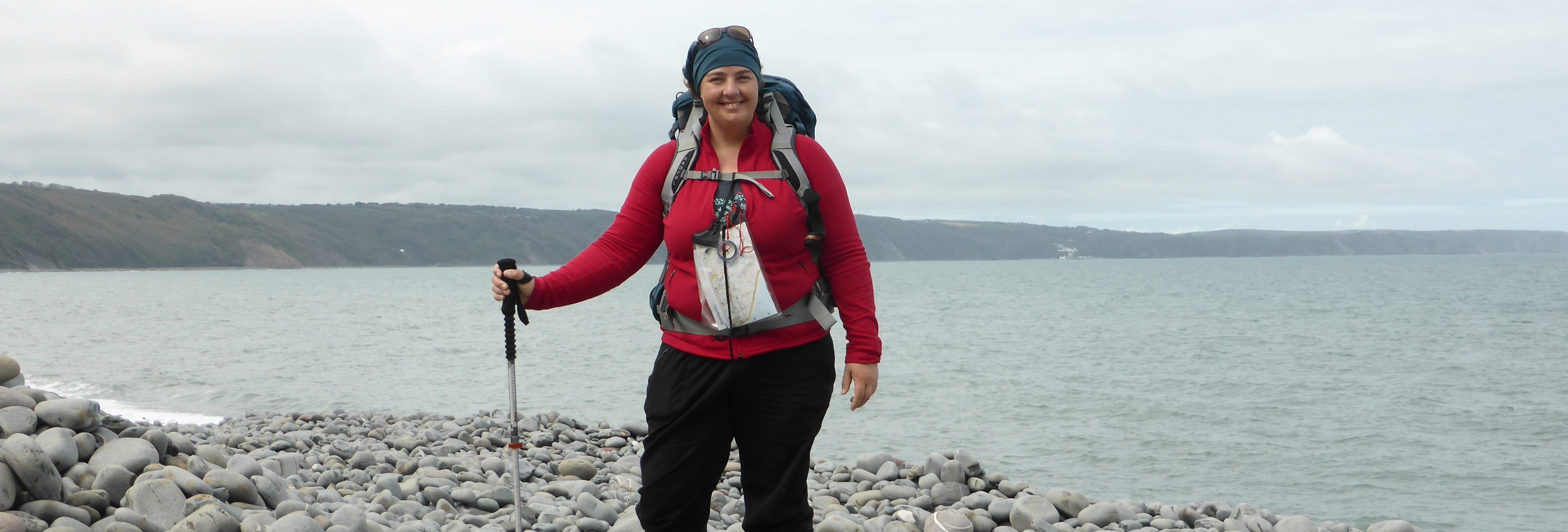
Porlock to Lynmouth
Up very early this morning – jet lag I guess – so I got a little diary writing done. In discussing the various ways to return to the coast path, Chris, of Chris and Sue who ran the fabulous Rose Bank B&B in Porlock, advised me to try Coleridge Way up to Porlock Weir. This would take me above the town of West Porlock. Big mistake! BIG!!! It looks innocuous on the map – as the entire swcp does on first glance – but the immediate up-down was too much for my cold, sore muscles. Those up-downs, however, turned out to be minuscule in comparison to the down-ups of the rest of the day.
For those of you confused about the up-downs and the down-ups, let me illuminate them for you. An up-down is where you start low, you go up, and then you go down. The old ‘what goes up, must come down’ maxim. But most of the swcp is actually down-ups where you start high, go down, and then immediately come back up. When you’re on the swcp and you see a drop off ahead, you know there’s pain afoot.


The first couple of kilometres past the Worthy Toll House (pic obove), and through the beautiful Yearnor Wood, was relatively calm, and I was soon joined in my walk by a gentleman who turned out to be a descendent of Coleridge (yes, the poet). A shout out here goes to John Coleridge. Thanks for keeping me company for a bit. He does a pilgrimage walk (almost) every year to the super-cute Culbone Church. If I remember rightly, it dated back to 1270 (I could be very wrong there). John was keen to show me the screen hanging on the stone wall with the ten commandments written in large lettering for, as he explained it, the hard-of-sight parishioners from centuries past who had no access to reading glasses.


John and I shared a bit of philosophy on life, and then I was on my way again. Immediately, I was faced with a choice: the high path or the low path. And, believe me, I have sung that song many times over the course of this walk. A multitude of combes (deep, narrow valleys dug out of the high moorland cliffs by streams) meant the high path might have been crazy difficult, so I took the low path through Culbone Wood, which was providential because before long I came across Ambre the Belgian exchange student. A shout out to Ambre (pronounced Ombray) who kept me company for much of the exhausting day.
We delighted in the Culbone Wood, and then Embelle Wood, with their ancient-looking wind-warped trees and lashings of moss. We both fancied these woods to be quite magical and a little scary. Even within the enclosing safety of the woods, the steep fall-off down to the rocks and the sea far below kept us both leaning to the left side of the narrow path, and carefully stopping to take in the view of the Bristol Channel and the Wales coast line far off on the horizon.


At last clearing Yenworthy Wood, the aptly named Desolation Point, and Chubhill Wood, we climbed up the saddle beyond Kipscombe Combe and saw before us The Foreland – a raw, rock-strewn, wind-ripped headland. After nearly twenty km, we were both pretty worn out and it was an exhausting climb up the shale-rubble path. By the time we reached that peak, we felt the gale ripping in from the north west, and saw both Great Red and Butter Hill peaks ahead. My walk rate was down to about 2 km/hr and I urged Ambre to continue on faster to get to her camp site in time to set up before dark. My load may have been lightened, but I was definitely feeling the effort of the day.
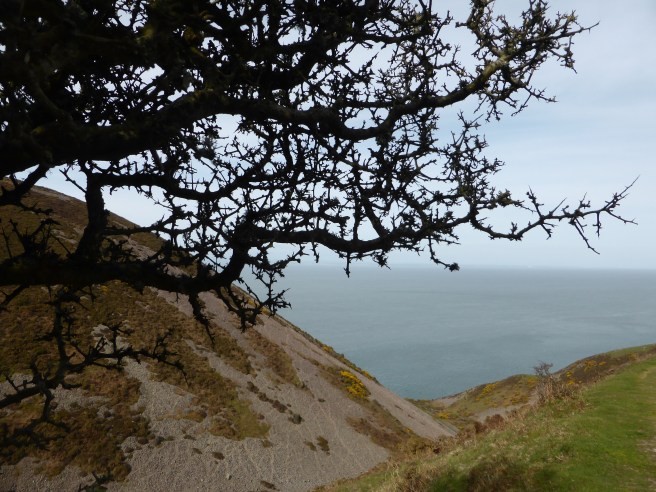
Only a few km to go along the cliff path above the horribly-named Upper Blackhead and Lower Blackhead, but they took me over an hour. The wind was close to gale force, and I had nothing but short grass to catch my fall down what was probably a 250 meter, 70 degree drop. It wouldn’t be the only time I thanked my lucky stars for being convinced to buy walking sticks.
When I reached Lynmouth pier, I was done in. But, desperation had me racing (hobbling slowly) to my hotel in time to arrange for a luggage transfer for the following day. Much like on day one, I obsessed on day two about the effort involved in carrying the beast on my back along such a challenging path. Anyone who’s been to the twin towns of Lynton/Lynmouth will know, however, that Lynmouth is a black hole of network and phone coverage. When I finally reached the Rock Hotel Guest House all I cared about was finding a bag for my non-essential-to-walk- with stuff and contacting Luggage Transfers. The young guy who signed me in gave me a black rubbish bag and a baffled look. He just didn’t get it.
A big thank you goes to Emilio – the colourful owner of the Rock Hotel (I later found out he was an ordained priest who does local services in Latin, but my first impression of him was of someone who needs anger-management therapy. I later-later found out he was also an identical twin – which might explain the personality duopoly) – who must have seen the desperation behind my exhaustion because he placed the call for me and I could finally (finally!) collapse.
[Surge stats: 20.51 km, 209 floors, 34256 steps]

 PenLoper